Handles the widest range of cases
Fixed brackets and wires can move teeth in ways removable trays cannot, which is why metal braces remain the default for complex crowding, rotations and bite correction.

Treatments
The most widely used type of braces, and the one that can correct the widest range of cases — fitted at our Aventura office by four orthodontists, all licensed and certified.

The classic option
Metal braces are commonly made out of stainless steel, which are sometimes combined with nickel titanium or gold if a person is allergic to nickel.
Every tooth carries its own small bracket on the outer surface, and one thin archwire threads through the whole arch. The wire wants to return to its own shape, and as it does it applies light, continuous pressure that walks each tooth towards its planned position. Changing the wire at each visit adjusts how much force is applied and where.
Because every tooth is gripped individually, this is the most controllable way to move teeth — which is why it still treats cases that other approaches cannot.
Metal braces are the oldest option on this page and they remain the most used one, for reasons that have nothing to do with cost alone.
Fixed brackets and wires can move teeth in ways removable trays cannot, which is why metal braces remain the default for complex crowding, rotations and bite correction.
Because they are bonded in place, they work every hour of every day. There is no compliance to track — a practical advantage for younger patients.
Stainless steel tolerates ordinary eating and daily brushing over a course of treatment that often runs many months.
The small elastics that hold the wire come in a range of colours and are changed at each adjustment, so children and teens can pick something new every visit.
From the first appointment to the day the braces come off — and the part afterwards that decides whether the result lasts.
We examine your teeth and bite and take a free digital panoramic X-ray. You leave knowing which options suit your case, what each involves and what it costs.
Each tooth is cleaned and a bracket is bonded to it, then the archwire is placed and secured. You eat softer foods for the first few days while your teeth settle.
You come back at set intervals so we can change the wire and check progress. Visits are short, and this is when new elastic colours go on.
When the bite is where it should be, the brackets come off and your teeth are polished. A retainer then holds the result — the finished position is only kept if the retainer is worn as directed.
The questions we are asked most often. Anything not covered here, ask us at your free consultation — it includes a free digital panoramic X-ray.
Having them fitted does not hurt — nothing is drilled and no injection is needed. Teeth usually feel tender for a few days afterwards, and again for a day or so after each adjustment, because they are being moved. Soft food and ordinary pain relief cover it.
It depends on what is being corrected and how your teeth respond. We give you an estimate at your free consultation, once we have seen your X-ray and examined your bite, rather than quoting a number before we have looked.
Hard and sticky foods are what break brackets and bend wires — ice, nuts, hard rolls, caramel, chewing gum. Cutting firmer foods such as apples and carrots into pieces rather than biting into them avoids most breakages.
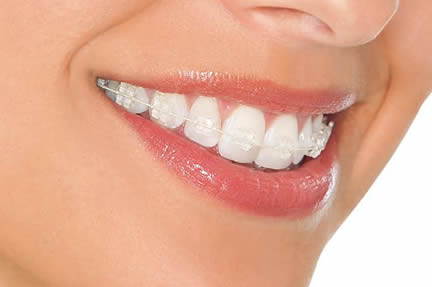
They are visible, though modern brackets are considerably smaller than those most adults remember. If appearance is your main concern, clear/ceramic braces cover the same ground more discreetly.
Tell us at your consultation. As the practice notes above, stainless steel is sometimes combined with nickel titanium or gold, and there are alternatives for patients with a nickel allergy.
Which one suits you depends on your bite, your treatment time and how visible you want the braces to be. See them all on the braces overview.
Ready when you are
Your free consultation includes a free digital panoramic X-ray. All orthodontic options and financial options are presented while considering duration of the treatment and insurance coverage.